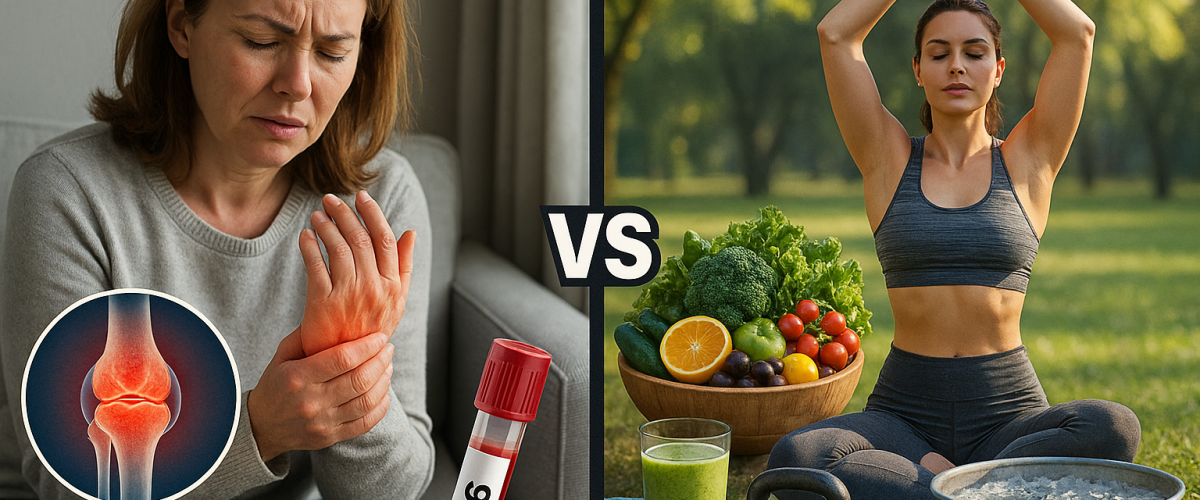
14.1 Autoimmune Disease vs Healthy Life Style Differences

ChatGPT Image Nov 5, 2025, 12_34_21 AM

I recently came to realize that health advice suitable for healthy individuals may not apply to those with autoimmune disorders. These conditions include arthritis, type 1 diabetes, psoriasis, vasculitis, Crohn’s disease, celiac disease, gastritis, and others.

Healthy individuals aim to strengthen their immune systems by exposing their bodies to mild stressors, allowing them to recover stronger over time. However, applying the same principle to autoimmune patients can be harmful, as their already overactive immune systems may become even more reactive, worsening symptoms over time. In such cases, the very “immune-boosting” advice commonly promoted can actually cause harm. I investigated this further by reviewing journal articles, and here are my findings.

IL-6 and Immune Activation

IL-6 is a powerful cytokine biomarker that triggers immune responses when the body faces stress, infection, or inflammation. Elevated IL-6 levels are associated with an overactive immune system, which can exacerbate autoimmune conditions.

Heat and Sauna

One popular immune-strengthening method among healthy individuals is the use of hot saunas or heated yoga sessions. I have personally practiced these for almost 10 years. However, Dr. Hans Selye—the father of stress theory—discovered the effects of stress by subjecting animals to heat stress. This means I have essentially been exposing my body to a form of controlled stress. A clinical study compared yoga performed at 104°F and at 74°F. The results showed that heat exposure triggers IL-6 release, signaling the body to respond to stress. This response helps build a stronger immune system over time, similar to how muscles grow after microdamage from workouts. However, for individuals with autoimmune disorders, this IL-6 spike can cause harmful effects such as joint swelling, fatigue, ulcers, psoriatic or arthritic flare-ups, insomnia, fever, and chills. Therefore, frequent or prolonged exposure to heat stress (e.g., saunas, hot yoga) may worsen their symptoms.

Fasting

Intermittent fasting has shown substantial benefits in healthy populations, but the effects on autoimmune-prone individuals are more complex. Two factors must be considered: short-term effects and long-term outcomes. Immediately after eating—especially red meat—IL-6 levels rise. However, fasting does not necessarily lead to an immediate drop in IL-6. Research findings are mixed, though some studies show that fasting benefits individuals with rheumatoid arthritis over time. One long-term study observed a 37% reduction in IL-6 levels after seven days of fasting. These findings suggest that while short-term IL-6 fluctuations during fasting remain unclear, long-term fasting may benefit both healthy individuals and those with autoimmune conditions.

Cold Plunge

Cold plunges trigger an immediate immune response, increasing IL-6 levels as the body reacts to sudden cold exposure. For healthy individuals, this can be beneficial, but for autoimmune patients, it can worsen inflammation. Thus, cold plunges should be avoided by those with autoimmune disorders.

Exercise and Physical Activity

Exercise elicits an immune response to repair the body post-exercise. In one very interesting study, cystic fibrosis patients, whose bodies release IL-6 leading to inflammation, showed decreased IL-6 levels with daily physical activity. This may be a roundabout way to say everyone must have physical activity. But what about strenuous exercise and its extreme version—bodybuilding? Studies suggest intense exercise leads to inflammation. Both IL-6 and IL-10 levels went up, but with low-intensity exercise, these levels didn’t change. Research shows that aerobic endurance athletes, like elite cyclists, have lower white blood cell counts measured over the long term. However, long-term IL-6 levels were the same as in the normal population. Based on these results, for individuals with autoimmune disorders, low to moderate aerobic exercise with rest in between and prolonged activity is a better option. Gardening, cycling, walking (not running, since the impact on the knees is high), room-temperature yoga, stretching, low-impact full-body workouts, dancing, aerobics, and swimming could be effective low-impact endurance physical activities. Many bodybuilders use steroids, causing highly inflamed bodies and enlarged livers and hearts, which can lead to organ failur

Outdoor Activity

The outdoor environment is rich in oxygen, which supports overall health, but it can also trigger allergies and further activate the immune system in response to allergens. Therefore, for individuals with autoimmune conditions, spending time outdoors may initially cause discomfort or flare-ups. However, over time, gradual and consistent outdoor exposure can help the immune system adapt and become less reactive. Hence, autoimmune individuals should aim for moderate, measurable daily exposure to outdoor activities—such as walking, light gardening, or yard work—rather than engaging in sudden or prolonged outdoor exertion.

Drug or Surgery Induced Inflammation

This brings up a very interesting perspective on the use of research data. Some individuals who do not naturally have inflammation develop it as a result of strong therapies, such as anti-cancer treatments, which dramatically induce immune responses and inflammation. The methods that help these patients reduce inflammation may also be beneficial for individuals with autoimmune disorders. One particular study revealed that daily exercise plays a crucial role in reducing inflammation. A combination of low-impact aerobic activity and resistance training produced the best outcomes for cancer patients in lowering inflammatory biomarkers. Similar studies involving other forms of physiological stress that activate the immune system suggest that these findings could also be applied to people with autoimmune conditions.

Anti-inflammatory Workout Diet

All this research leads us to an important question: if exercise induces inflammation but daily physical activity is necessary, what type of diet—before, during, or immediately after a workout—can help quickly reduce that inflammation? It turns out that a diet rich in carbohydrates and polyphenols helps lower inflammation. Consuming polyphenol- and carbohydrate-rich vegetable and fruit drinks can be beneficial; some examples are available on my website, www.alexfreeman.org. Although dairy products are high in protein, they tend to be inflammatory and should be avoided before and after exercise. A whole-grain diet, compared to one based on refined grains, has been shown to reduce IL-6 levels. Based on this, it can be concluded that consuming recovery or body-healing supplements before and after workouts may also help decrease inflammation. Turmeric is one of the most effective natural anti-inflammatories. It can be used in many forms—sprinkled as a powder over food, brewed as a tea using the root, or incorporated into other recipes. (A tea recipe is available on my website as well.) Potassium intake is especially beneficial for individuals with rheumatoid arthritis (RA). Increasing the consumption of green leafy vegetables naturally raises potassium levels. Additionally, probiotics are well known for their ability to reduce inflammation and support gut health.

1. Acute Physiologic Effects of Performing Yoga in The Heat on Energy Expenditure, Range of Motion, and Inflammatory Biomarkers BRADLEY S. LAMBERT, Int J Exerc Sci. 2020 May 1;13(3):802-817. doi: 10.70252/AKMZ9424. eCollection 2020.

2. Time-restricted eating effects on performance, immune function, and body composition in elite cyclists: a randomized controlled trial, Tatiana Moro,  J Int Soc Sports Nutr. 2020 Dec 11;17(1):65. doi: 10.1186/s12970-020-00396-z

3.Serum levels of interleukin-6 and dehydroepiandrosterone sulphate in response to either fasting or a ketogenic diet in rheumatoid arthritis patients

Surgery-InducedD A Fraser, Clin Exp Rheumatol. 2000 May-Jun;18(3):357-62.


4.“Inflammatory effects of high and moderate intensity exercise – A systematic Review’, by Cerqueira, E, FRONTIERS IN PHYSIOLOGY, Volume10, DOI10.3389/fphys.2019.01550


5. “Lower white blood cell counts in elite athletes training for highly aerobic sports”, P Holt., European Journal of Applied Physiology, V110, p925-933, 2010.


6. “Exercise training, circulating cytokine levels and immune function in cancer survivors: A meta-analysis”, by Nasim Khosravi, Brain Behav Immun. 2019 Oct:81:92-104. doi: 10.1016/j.bbi.2019.08.187. Epub 2019 Aug 24

 7.“Carbohydrate and the cytokine response to 2.5 h of running, Authors: S. L. Nehlsen-Cannarella, et al., Journal of Applied Physiology, Volume 82, Issue 5, https://doi.org/10.1152/jappl.1997.82.5.1662

8.“Influence of a Polyphenol-Enriched Protein Powder on Exercise-Induced Inflammation and Oxidative Stress in Athletes: A Randomized Trial Using a Metabolomics Approach”, David C. Nieman et al., Published: August 15, 2013, https://doi.org/10.1371/journal.pone.0072215

 9. Whole grain-rich diet reduces body weight and systemic low-grade inflammation without inducing major changes of the gut microbiome: a randomised cross-over trial

Henrik Munch Roager, et al., Gut. 2019 Jan;68(1):83-93. doi: 10.1136/gutjnl-2017-314786. Epub 2017 Nov