1. Mountains and Minds
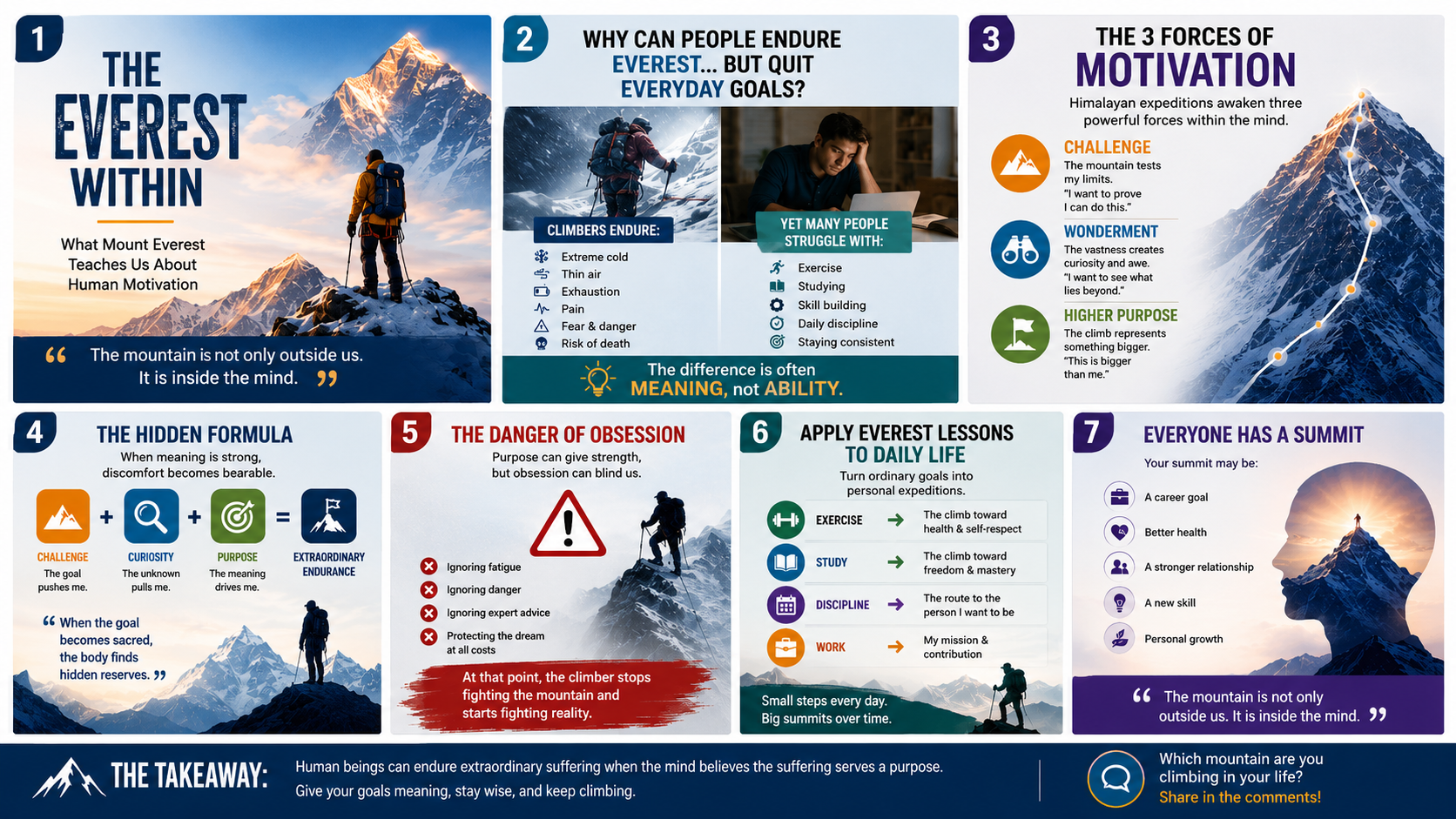
The human mind is capable of enduring far more than we usually imagine. This becomes strikingly clear when we watch people attempt to climb Mount Everest. They willingly enter a world of thin air, freezing temperatures, exhaustion, pain, and the real possibility of death. Watching such expeditions raises two powerful questions: Can we apply this same obsession to our inner goals? And what keeps that person moving when every part of the body is begging to stop?
This question matters because it is not only about mountains. It is about the mind and our inner mountains in our daily life.
If a person can endure brutal cold, hunger, fear, physical pain, and the threat of death in pursuit of a summit, why do we often struggle to endure the smaller discomforts of daily life? Why do we give up on simple goals, avoid minor pain, delay necessary work, or retreat from inconvenience? The mountain reveals something important: the limits we experience in ordinary life may not always be physical limits. Often, they are mental limits created by the meaning we attach — or fail to attach — to the task before us.
In earlier discussions, we identified three major forces of motivation: challenge, curiosity or wonderment, and a higher cause. Himalayan expeditions contain all three.
First, there is the challenge. Everest represents one of the greatest physical and psychological tests on earth. For many climbers, the mountain becomes a once-in-a-lifetime calling. The difficulty itself becomes the attraction. The danger gives the goal weight. The suffering gives the achievement meaning. The mind begins to say, “If I can do this, I will know something about myself that I could never know otherwise.”
Second, there is wonderment. The Himalayas are not merely a place of danger; they are also a place of awe. The vastness, silence, snow, sky, and scale of the mountains create a sense of mystery. The climber is not only chasing a record or a photograph. He or she is being pulled by curiosity — by the desire to stand in a place few humans have stood, to see the world from a height that feels almost outside ordinary life.
Third, there is the higher cause. For some climbers, the summit represents more than personal success. It may represent national pride, family honor, a message to society, a tribute to someone, a sponsor’s dream, or proof that human limits can be pushed. Once the climb is tied to a larger meaning, turning back becomes psychologically harder. The decision is no longer simply, “Should I continue?” It becomes, “What does it mean if I stop?”
This is where the mind becomes both powerful and dangerous.
Based on the model of obsession we developed elsewhere, both pain and pleasure shape decision-making. The pleasure is obvious: the joy of reaching the summit, the pride of achievement, the admiration of others, the fulfillment of a dream. But the pain is just as powerful. There is the pain of abandoning the climb after years of preparation. The pain of losing face in front of sponsors, friends, family, or society. The pain of knowing that another attempt may be financially impossible. The pain of watching a lifelong dream collapse within sight of the summit.
That pain can become so intense that it clouds judgment. The climber may stop paying attention to weather, fatigue, oxygen, timing, or warnings from guides. The spirit of challenge, which first created courage, can slowly turn into stubbornness. The higher cause, which first gave meaning, can become a trap. The mind begins to protect the dream even when the body is sending signals of danger.
At that point, the climber is no longer only climbing the mountain. The climber is fighting his mind.
To turn back may feel like more than a practical decision. It may feel like losing the identity that was built around the climb. The person may think, “If I do not reach the summit, then all this suffering, preparation, hope, money, and sacrifice meant nothing.” That thought can be unbearable. So some continue forward, even when continuing may cost them their lives.
This reveals the immense power of meaning. Human beings can endure extraordinary suffering when the mind believes the suffering serves a purpose. Pain becomes tolerable when it is connected to identity, mission, pride, love, curiosity, or transcendence. The same cold, exhaustion, and fear that would seem impossible in ordinary life become bearable when they are placed inside a powerful story.
The lesson is not that we should become reckless. The lesson is that motivation depends on meaning.
In daily life, many of our goals fail because we do not attach enough meaning to them. We say we want to exercise, study, build a skill, improve our health, repair a relationship, or complete a project, but the goal remains mentally small. The discomfort feels larger than the purpose. A few minutes of boredom, tiredness, embarrassment, or inconvenience can defeat us because the mind has not connected the task to a deeper reason.
The Everest climber shows us the opposite. When the goal becomes sacred in the mind, the body finds hidden reserves. The person continues despite pain because stopping feels more painful than continuing.
If we could wisely attach that kind of meaning to our ordinary goals, we could create immense motivation without needing a mountain. We could make simple daily actions part of a larger personal expedition. Exercise would no longer be just exercise; it would become the climb toward health and self-respect. Study would no longer be just study; it would become the climb toward freedom and mastery. Discipline would no longer be punishment; it would become the route to the person we are trying to become.
The mountain, then, is not only outside us. It is inside the mind.
Every person has a summit: a goal that requires discomfort, patience, courage, and persistence. The question is whether we can give that goal enough meaning to endure the small pains that stand between us and the top. The same mind that can carry a climber through ice, wind, and exhaustion can also carry us through the ordinary struggles of daily life — if we learn how to use challenge, wonderment, and higher purpose to awaken it.