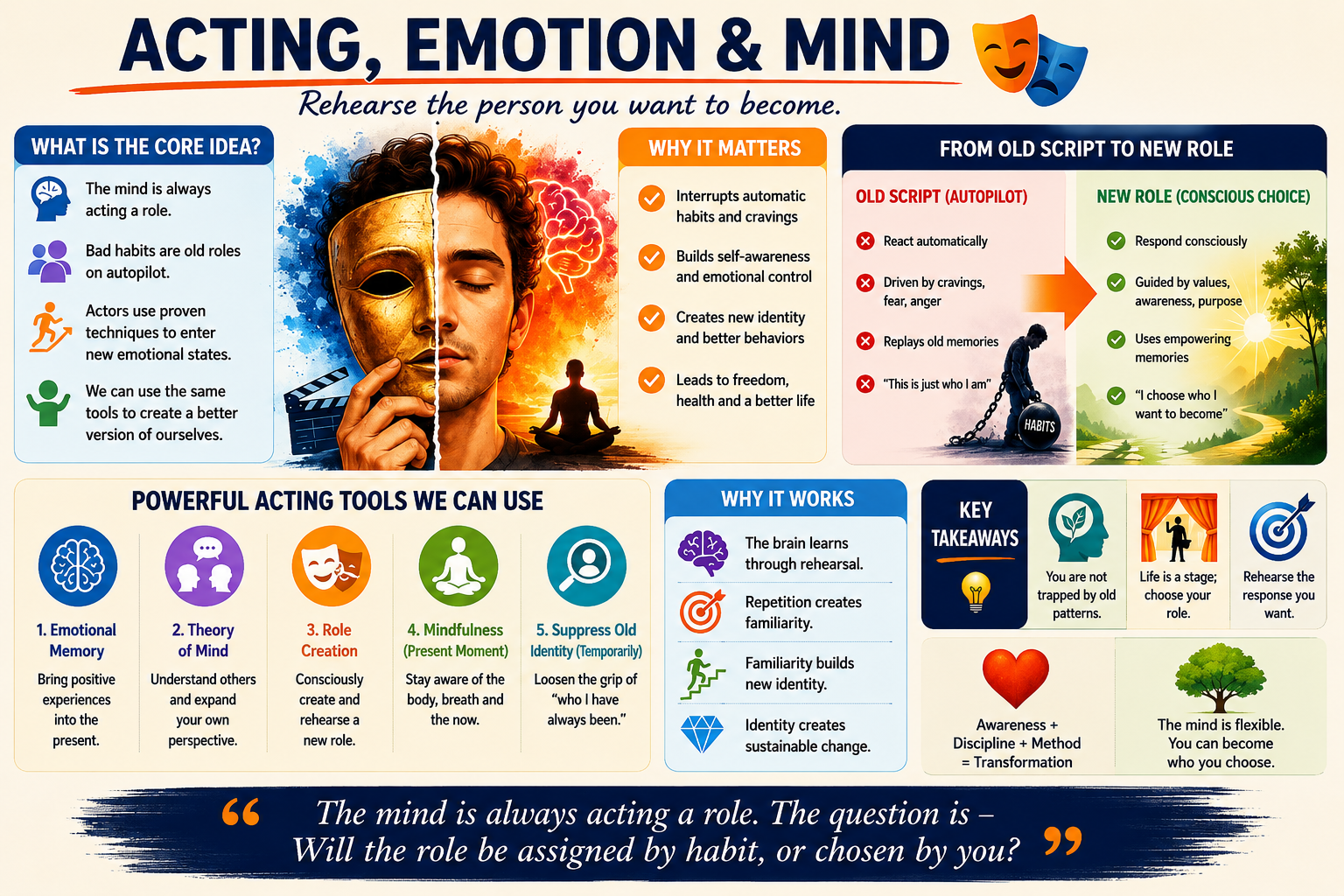
19.1 Acting, Emotion, and Mind

How do actors enter emotional roles so convincingly? How can someone walk onto a stage, or stand before a camera and suddenly become grief, anger, courage, fear, love, or forgiveness?

This question is not only about acting. It is about the mind.

When we try to overcome bad habits, addictions, cravings, anger, anxiety, or self-defeating patterns, we are also trying to play a new role. We are trying to become a version of ourselves that does not automatically obey the old script. The person who used to drink, overeat, shop impulsively, erupt in anger, or collapse into fear must slowly be replaced by another character — calmer, stronger, more disciplined, and more aware.

In that sense, minding our thoughts is a form of conscious role creation. We are not pretending in a shallow way. We are rehearsing the person we want to become until the mind begins to accept that role as real.

This is why the psychology of acting can teach us so much. Actors have developed practical tools for entering emotional states, understanding other minds, suppressing their ordinary self-identity, and becoming present in a new role. These same tools can help us interrupt bad habits and redirect emotional energy toward better health and a better life.

Earlier acting styles were often more theatrical, with exaggerated gestures, dramatic facial expressions, and visible emotional display. But modern acting became more powerful when performers learned to work from the inside out. Instead of merely showing anger, they remembered anger. Instead of pretending to grieve, they touched a real memory of grief. Instead of acting bravely, they entered an inner state where courage felt necessary.

This approach is often associated with Stanislavski, and later developed in different ways by teachers such as Lee Strasberg, Michael Chekhov, and Uta Hagen. The basic idea is simple but profound: emotion can be awakened through memory, imagination, and identification.

We already know this from ordinary life. We can become angry merely by remembering an old insult. We can feel sadness by replaying a loss. We can feel warmth by remembering someone who loved us. The body responds as if the event is partly happening again. The mind not only remembers emotion; it can re-enter emotion.

This same mechanism can be used deliberately for healing.

For example, suppose we are angry at someone. The old script says: replay the offense, strengthen the anger, justify the resentment, and carry the poison forward.

But we can choose another emotional memory.

We can remember a time when we forgave someone and felt released. We can remember the lightness that followed. We can bring that earlier state into the present situation and allow it to soften the current anger.

The actor uses emotional memory to become a character. We can use emotional memory to become a better version of ourselves.

A performer playing a heroic role may recall a moment from personal life when they felt wronged, determined, protective, or brave. That memory then fuels the scene. In the same way, we can summon past moments of discipline, kindness, restraint, courage, or forgiveness, and apply them to the present temptation.

The will must meet the method.

Discipline alone is often too dry. The method gives discipline a path.

The second major acting tool is Theory of Mind, which means the ability to understand another person’s mental and emotional state.

A good actor does not merely memorize lines. The actor asks:

“What does this character believe?”

“What does this person fear?”

“What do they want?”

“What are they hiding?”

“What do they think others think of them?”

By entering the mental world of the character, the performance becomes more realistic.

Research on acting, empathy, and Theory of Mind suggests that practicing dramatic roles can strengthen the ability to imagine and understand other people’s perspectives [1].

This is important for self-change because many bad habits survive inside a narrow self-view. The mind says:

“I want this.”

“I need this.”

“I always do this.”

“This is who I am.”

Acting breaks that rigidity. It teaches the mind that other roles are possible. Suppose we struggle with compulsive shopping. The old character says:

“Shopping is exciting.”

“I need to look.”

“I may find something.”

“I deserve this.”

“It is harmless.”

But we can consciously create a new character — someone who dislikes shopping.

This character sees shopping as tiring, confusing, expensive, and mentally noisy. This character dislikes searching through endless products, comparing colors, reading labels, checking online reviews, returning items, and wondering whether the purchase was a mistake.

Now we rehearse that role.

We imagine walking into a store as that character.

We imagine scrolling through online products as that character. We imagine feeling not excitement, but boredom and resistance. Slowly, the emotional attraction weakens.

Shopping is no longer framed as pleasure. It becomes an inconvenience. This can be applied to many cravings.

We can act as the person who does not want alcohol, who does not enjoy overeating, who does not need to win every argument, who does not chase social approval, who does not collapse into jealousy, and who does not respond to stress with self-destruction.

At first, it feels like acting.

But repeated acting becomes rehearsal. Rehearsal becomes familiarity.

Familiarity becomes identity.

The mind learns through performance.

Another technique actors use is the temporary suppression of ordinary self-identity.

To become a role, the actor must loosen the grip of the usual self:

“My name.”

“My history.”

“My habits.”

“My preferences.”

“My fears.”

The present role becomes more important than the past identity. For a moment, the actor is not trapped inside

“who I have always been.”

This is deeply relevant to bad habits.

Many habits survive because they are attached to identity.

“I am an anxious person.”

“I am a drinker.”

“I am short-tempered.”

“I am not disciplined.”

“I always give in.”

These statements become mental prisons. They make the past feel permanent. But acting teaches the opposite: identity is more flexible than we think.

Mindfulness helps here because it trains us to enter the present moment more fully. Instead of being lost in old stories, we become aware of the body, breath, surroundings, and current experience.

Research on mindfulness suggests that present-moment awareness is associated with psychological well-being [2].

For our purposes, mindfulness allows us to step into the new role with more attention and less interference from the old self.

There is an important distinction between internal state awareness and self-rumination.

Internal awareness means noticing what is happening now:

Tension in the body. Craving in the mouth. Heat in the chest.

Fear in the stomach.

Thoughts moving through the mind. Rumination is different.

Rumination keeps circling the self:

“Why am I like this?”

“Why did this happen to me?”

“What is wrong with me?”

“Why can’t I change?”

Research distinguishing reflection from rumination shows that self-focus can be useful or harmful depending on whether it leads to insight or repetitive distress [3].

So, the goal is not to obsess over the self. The goal is to observe the self.

An actor does this naturally. The actor notices the body, voice, posture, emotion, and intention in the present scene.

We can do the same.

In a moment of craving, we can say:

“The old character is appearing.”

“The body is asking for the old reward.”

“The mind is preparing the old excuse.”

“But I am rehearsing a new role now.”

This is not denial.

It is disciplined awareness.

Why use acting to control bad habits?

Because all self-change requires us to interrupt the automatic role we have been playing.

Addiction and habit are not merely chemical or behavioral loops. They are also identity loops. They come with language, posture, memory, emotional triggers, social cues, and repeated scenes.

To change the habit, we must change the role. The angry person must rehearse calm.

The fearful person must rehearse courage. The impulsive person must rehearse restraint. The addicted person must rehearse freedom.

The self-absorbed person must rehearse empathy.

This does not mean medical intervention is unnecessary. For serious addictions, trauma, depression, anxiety disorders, or other mental health conditions, professional help may be essential.

But alongside medical or therapeutic care, it is still valuable for us to understand our own minds. We need tools that we can practice daily.

We need ways to manage the small scenes of life where habits are triggered. Acting gives us such tools.

It teaches us to use memory instead of being used by memory.

It teaches us to enter emotion instead of being ambushed by emotion.

It teaches us to imagine another mind instead of being trapped inside our own. It teaches us to loosen identity instead of obeying the sentence:

“This is just who I am.”

The more flexible the mind becomes, the less trapped we are by old patterns. A rigid mind repeats.

A flexible mind rehearses, adapts, reframes, and becomes. In this way, acting is not an escape from reality.

It is training for reality.

We practice the role before life demands it.

Then, when the real moment comes  the drink, the insult, the craving, the fear, the temptation, the anger

We are not empty-handed.

We have rehearsed another response. The mind is always acting a role.

The question is whether the role was assigned by habit, pain, society, and addiction — or consciously chosen by us.

Endnotes

1. Thalia Goldstein and Ellen Winner, “Enhancing Empathy and Theory of Mind,” Journal of Cognition and Development, 2012, 13, 19–37.

2. Kirk Warren Brown and Richard Ryan, “The Benefits of Being Present: Mindfulness and Its Role in Psychological Well-Being,” Journal of Personality and Social Psychology, 2003, Vol. 84, No. 4, pp. 822–848.

3. Paul Trapnell and Jennifer D. Campbell, “Private Self-Consciousness and the Five-Factor Model of Personality: Distinguishing Rumination From Reflection,” Journal of Personality and Social Psychology, 1999, Vol. 76, No. 2, pp. 284–304.