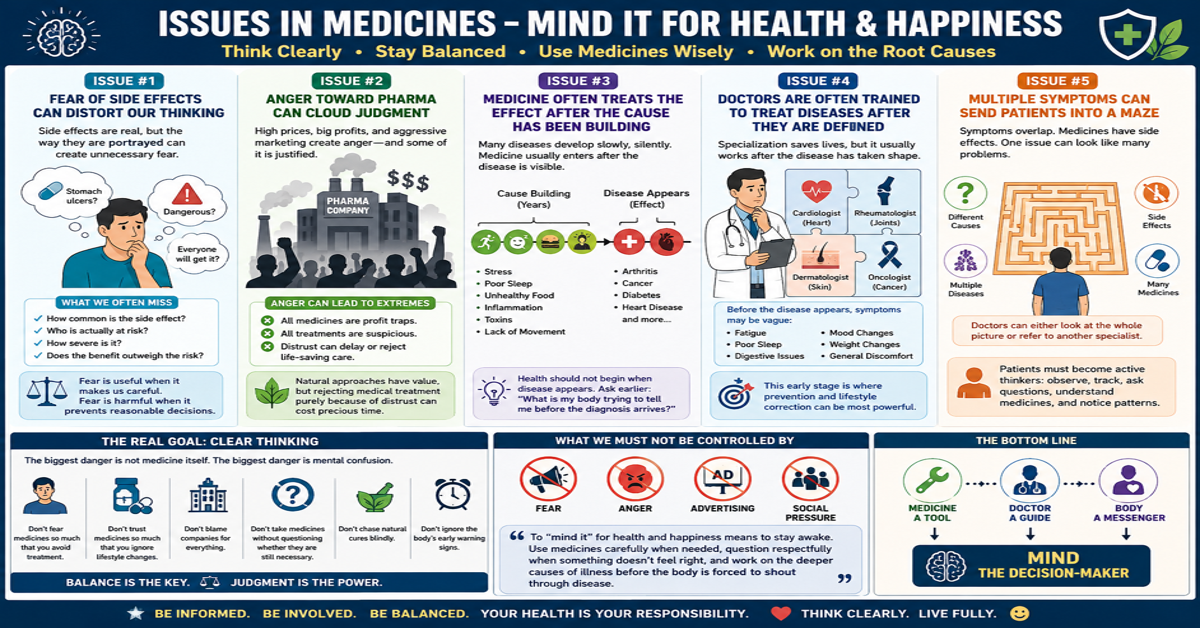
Before we dismiss medicines as dangerous or consume them casually as if they are harmless, we need to understand the deeper issues within medicine, medical decision-making, and the healthcare system. The truth is not as simple as “drugs are bad” or “drugs are good.” Medicines exist within a complicated world of biology, chemistry, regulation, business, patient behavior, and physician training. To make wise decisions, we have to look beyond the noise.
Issue #1: Side Effects
Side effects are one of the most misunderstood aspects of medicine. The media and the public often swing too far in the negative direction. Yes, medicines can have side effects. But side effects are not always measured with the same clarity as a drug’s therapeutic effects.
When a medicine is approved, its effectiveness and safety are studied. Researchers measure what dose produces what benefit, how many people respond, and how toxic the substance may be. However, side effects are often more difficult to quantify in the same clear, dose-response way. For example, if a drug can contribute to ulcers, we may know that ulcers are a possible side effect, but we may not fully understand how severe that risk becomes at each dose, how it varies from person to person, or how many patients are meaningfully affected in real-world use.
This creates a gap. The benefits of a medicine are often discussed in measurable terms, while side effects are discussed in broader, less precise terms. Some side-effect data may be difficult for the public to interpret, may be buried within large datasets, or may not receive the same clear presentation as efficacy data.
The result is confusion. The media may amplify side effects without explaining the degree of risk, the dose-response relationship, or the population affected. The public then hears “side effect” and assumes danger across the board. This can lead people to reject medicines that may actually help them. The real issue is not whether side effects exist. They do. The issue is whether patients are given a clear, measurable, and balanced understanding of risk versus benefit.
Issue #2: Profits
The second issue is profit. Drug companies are often criticized for making money, and sometimes that criticism is deserved. There are legitimate concerns about price gouging, access, and the tactics used to maintain pricing power. At the same time, the public conversation can become overly simplistic, as though pharmaceutical companies should function like government agencies rather than businesses.
Every industry tries to protect its pricing and market position. We see this in diamonds, milk, technology, food, and nearly every other sector. Pharmaceutical companies are no different. The problem is that medicine is not just another product. It affects life, death, suffering, and quality of life. That makes the profit question emotionally charged and morally complicated.
However, we must separate the business issue from the biological and chemical issues. The price of a drug, the behavior of a company, and the profit structure of the industry are not the same as whether a medicine works, whether a disease is being properly treated, or whether better alternatives exist.
When people become consumed by anger toward pharmaceutical profits, they may lose sight of the actual medical questions: What is happening in the body? What is the disease process? What does the medicine do chemically? What alternatives exist? What are the risks of treating versus not treating?
Profit matters. Pricing matters. Access matters. But those concerns should not automatically lead us to reject the science of medicine itself.
Issue #3: Cause and Effect
One of the most important but least understood issues in medicine is the difference between treating the cause and treating the effect.
Many medicines are used after a disease has already appeared. In that situation, medicine is treating the effect. However, the cause may have been developing silently for years before the diagnosis. Inflammation, for example, can be a cause. Arthritis is one possible effect. By the time a patient goes to the doctor with arthritis, the underlying process may have been active for a long time.
The same idea applies to many chronic conditions. In cancer, we often say that early detection saves lives. That is true, but even early detection usually means detecting the disease at an early-effect stage, not necessarily at the original-cause stage. The biological process may have started much earlier.
This raises a critical question: Why do we wait until the disease is visible before we act?
Blood pressure is a good example. A person may have blood pressure that is elevated but not yet above the official treatment threshold. Over many years, that pressure may still cause damage. In some cases, controlling blood pressure earlier and more gently may prevent more serious problems later. Yet often, both doctors and patients wait until the number crosses a formal boundary before taking treatment seriously.
This is the difference between using medicine to influence a cause and using medicine to manage a disease after it has fully appeared. Unfortunately, this distinction is not widely understood by patients, and it is not always emphasized in medical practice. Doctors are often forced to spend most of their time with the sickest patients. Borderline or early-stage risks may not receive enough attention until they escalate.
The key phrase the public needs to understand is this: early, aggressive control of inflammation and underlying risk factors matters. People need to understand this before they become patients, not after the disease has already taken hold.
Issue #4: Specialization
Modern medicine is built around specialization. Doctors are trained to become experts in specific organs, systems, and diseases. This is valuable when a disease is already present. However, specialization often focuses on effects rather than causes.
At the early causal level, there may be no clear specialty. A single cause can contribute to multiple diseases. Poor diet, chronic inflammation, metabolic dysfunction, stress, environmental exposures, or lifestyle patterns may eventually manifest as heart disease, arthritis, diabetes, digestive disorders, or other conditions. Once that happens, the patient is sent from one specialist to another.
But who is responsible for addressing the cause before it becomes a disease?
Who is managing society’s consumption of processed foods, sugar, and refined carbohydrates? Who is responsible for cultural food habits that may be harmful over time? Who helps people understand the long-term consequences of what they eat, how they live, and how the marketplace shapes their choices?
This is not simply the doctor’s job. It is also the responsibility of markets, families, schools, communities, governments, nonprofits, and cultures. Yet there is often no single entity responsible for addressing the root causes at scale.
Education and awareness are essential. A significant portion of the money flowing into healthcare should be used to support prevention, public education, nutrition, and early intervention. Strong nonprofit and governmental efforts are needed in these areas. If society does not address the causes, medicine will continue chasing the effects.
Issue #5: Symptom Management
When causes are not addressed early, they eventually produce symptoms and diseases. At that point, the patient enters the medical maze.
A doctor may prescribe a medicine for one condition, but the medicine may create side effects or worsen another issue. The doctor then faces a choice: adjust the treatment and tailor the medication more carefully, or refer the patient to another specialist to manage the new symptom.
For example, if a patient takes a medicine for arthritis and experiences depression as a side effect, one approach is to continue the arthritis medicine and refer the patient to a therapist or psychiatrist. Another approach might be to reconsider the original medication. But who decides? Who looks at the whole picture? Who evaluates whether the healthcare system is solving the problem or multiplying the number of professionals involved?
This is where costs rise. One medicine leads to one side effect, which leads to another referral, which leads to another treatment. The patient is left trying to navigate a system in which diseases, medications, symptoms, side effects, and specialists all overlap.
At the end of the day, medicine is also a business. And when business models require year-over-year growth, especially when investor money is involved, incentives can become complicated.
Between side effects, profits, cause-and-effect confusion, specialization, and symptom management, patients are often not well informed. My goal is to help people step away from the noise and understand the system more clearly. We should not reject medicine blindly, and we should not accept it blindly. We should understand it.