How do actors enter emotional roles so convincingly? How can someone walk onto a stage, or stand before a camera and suddenly become grief, anger, courage, fear, love, or forgiveness?
This question is not only about acting. It is about the mind.
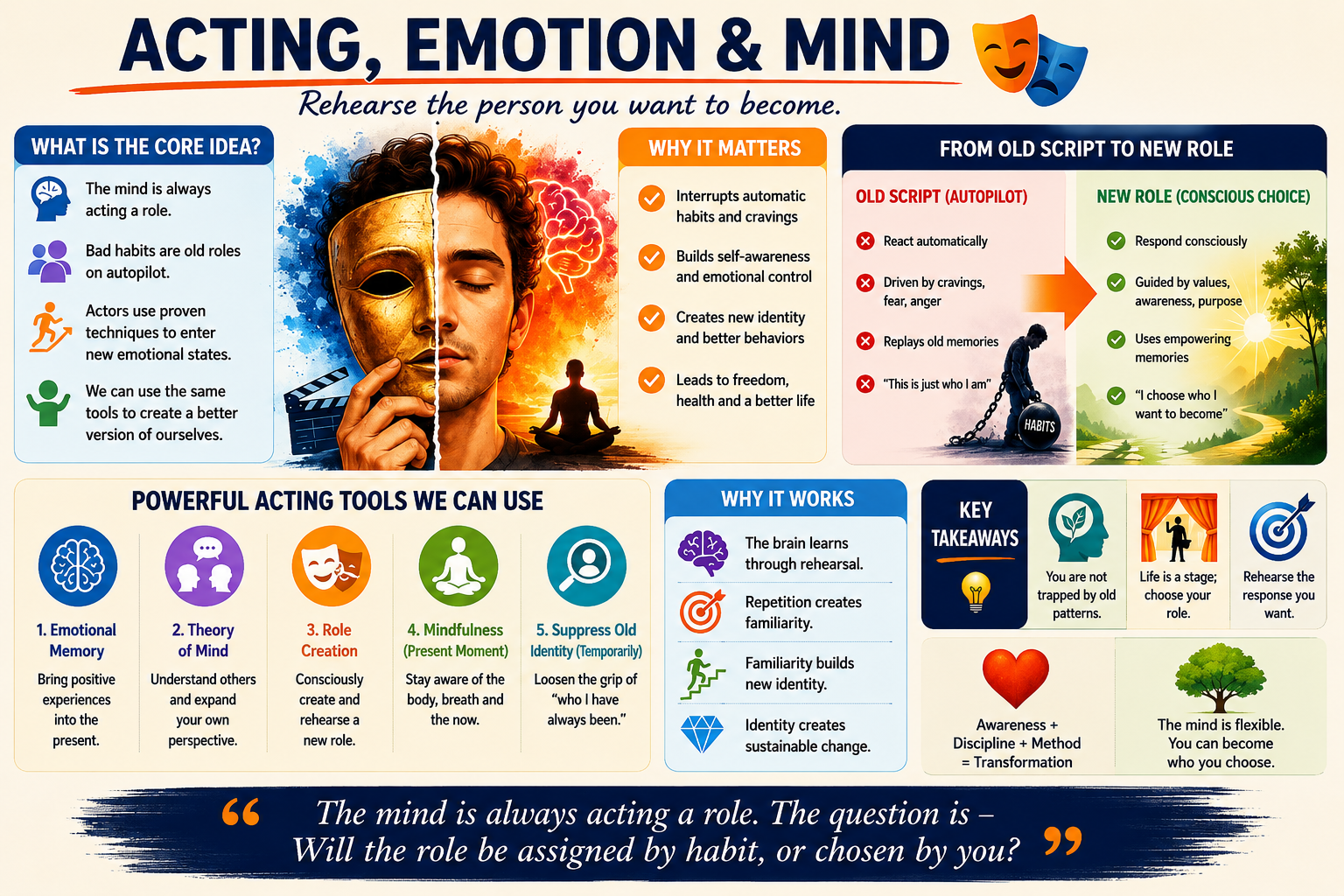
When we try to overcome bad habits, addictions, cravings, anger, anxiety, or self-defeating patterns, we are also trying to play a new role. We are trying to become a version of ourselves that does not automatically obey the old script. The person who used to drink, overeat, shop impulsively, erupt in anger, or collapse into fear must slowly be replaced by another character — calmer, stronger, more disciplined, and more aware.
In that sense, minding our thoughts is a form of conscious role creation. We are not pretending in a shallow way. We are rehearsing the person we want to become until the mind begins to accept that role as real.
This is why the psychology of acting can teach us so much. Actors have developed practical tools for entering emotional states, understanding other minds, suppressing their ordinary self-identity, and becoming present in a new role. These same tools can help us interrupt bad habits and redirect emotional energy toward better health and a better life.
Earlier acting styles were often more theatrical, with exaggerated gestures, dramatic facial expressions, and visible emotional display. But modern acting became more powerful when performers learned to work from the inside out. Instead of merely showing anger, they remembered anger. Instead of pretending to grieve, they touched a real memory of grief. Instead of acting bravely, they entered an inner state where courage felt necessary.
This approach is often associated with Stanislavski, and later developed in different ways by teachers such as Lee Strasberg, Michael Chekhov, and Uta Hagen. The basic idea is simple but profound: emotion can be awakened through memory, imagination, and identification.
We already know this from ordinary life. We can become angry merely by remembering an old insult. We can feel sadness by replaying a loss. We can feel warmth by remembering someone who loved us. The body responds as if the event is partly happening again. The mind not only remembers emotion; it can re-enter emotion.
This same mechanism can be used deliberately for healing.
For example, suppose we are angry at someone. The old script says: replay the offense, strengthen the anger, justify the resentment, and carry the poison forward.
But we can choose another emotional memory.
We can remember a time when we forgave someone and felt released. We can remember the lightness that followed. We can bring that earlier state into the present situation and allow it to soften the current anger.