I immigrated to the United States from India in the 1980s. Over the last four decades, I have watched the immigration system work beautifully, and then I watched it break.
May 26, 2026
18.1 Indian Immigration, H-1B Visas, and a Fix That Actually Works
What follows isn’t political posturing. It is an honest account from someone who has seen this issue from the inside as a student, a worker, and ultimately, a citizen. My goal is to spotlight what went wrong and offer a framework to fix it. But let me be clear upfront: the solution is not to harass the people who are already here. They simply played by the rules of the system they were given. The blame lies entirely with the policymakers and lobbyists who built a flawed structure without understanding its downstream consequences.
When the System Actually Worked
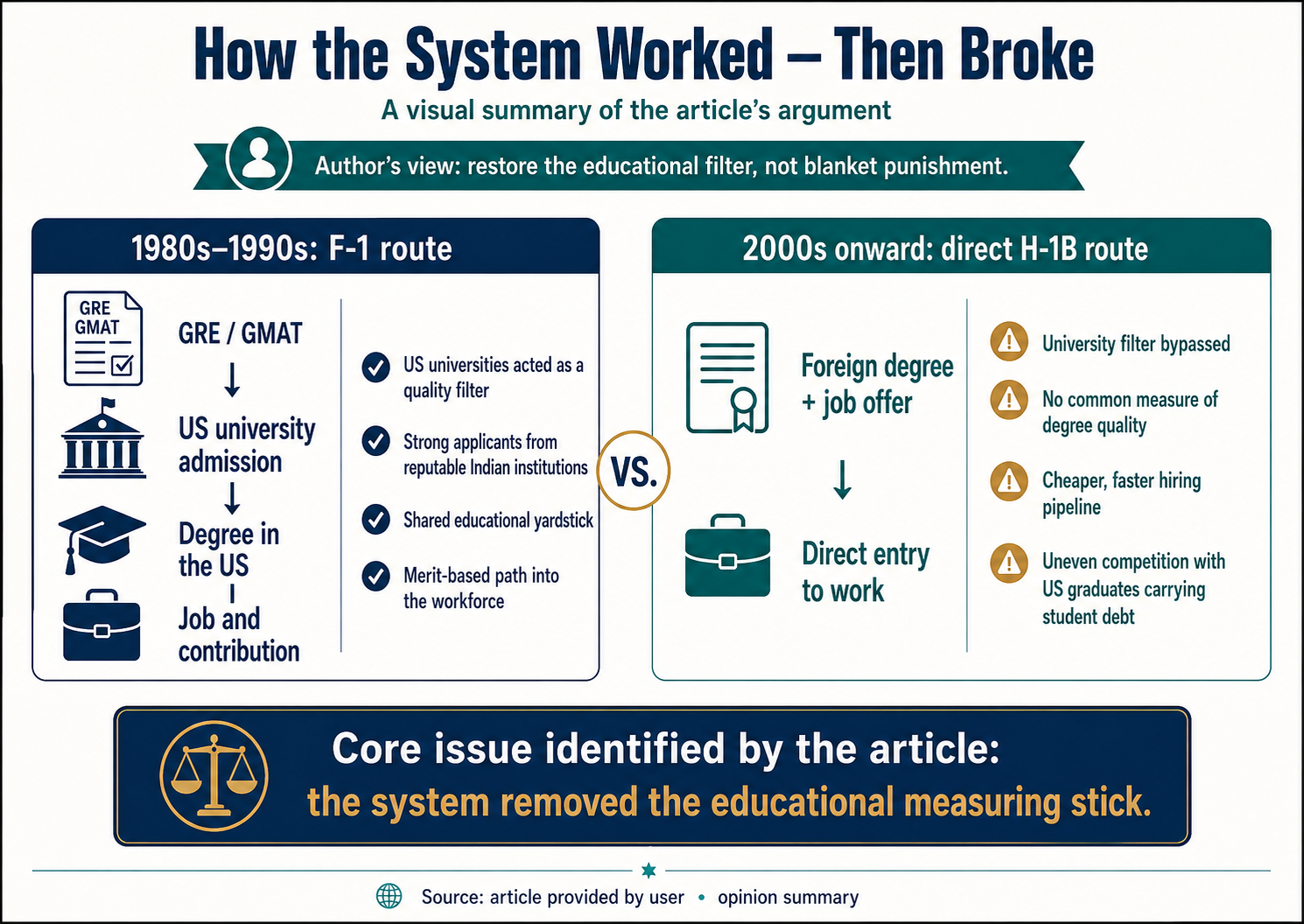
The original intent behind the F-1 student visa was a masterstroke of geopolitical strategy. The idea was to attract the brightest young minds from countries like India, run them through the rigorous filter of top-tier American universities, and allow the best of them to stay and contribute to the US economy.
In the 1980s and ’90s, this process worked exactly as intended. To even qualify, we had to take the GRE or GMAT. The scores had to be stellar, and the university acceptances had to be real. Only strong students from reputable Indian institutions made the cut, and only those admitted to credible American universities got visas. This created a genuine, objective, meritocratic filter.
Yes, this accelerated India’s “brain drain.” But that was a fair race—it forced India to compete by eventually creating better local jobs and institutions. Meanwhile, America benefited enormously from an unparalleled influx of talent.
What Broke and When
Everything changed in the 2000s. Driven by a booming tech market and corporate demands for cheaper, faster talent pipelines, corporate interest groups lobbied for a shortcut: the direct H-1B visa.
Instead of requiring skilled workers to first pass through the filter of the American higher education system, companies began hiring directly from abroad. This bypassed the university screening process entirely and destroyed our objective measuring stick. Suddenly, someone claiming a computer science degree from a tier-three institution in a mid-sized Indian city was placed on the exact same legal footing as an IIT graduate. No GRE, no GMAT, and no American university vetting—just a claimed degree and a job offer.
This created a wildly asymmetric playing field. While domestic students and legal immigrants on F-1 visas were accumulating tens of thousands of dollars in debt to earn their credentials through a rigorous US system, direct H-1B candidates walked in debt-free. Willing to accept lower salaries because any American wage represents a financial windfall compared to local standards, they inadvertently suppressed market wages and fueled resentment.
We threw away our only objective quality control mechanism.
A Policy Framework That Would Actually Work
The solution is not to shut America’s doors, but to restore the filter. Politicians need to stop tinkering blindly and implement a structured, balanced framework:
PROPOSED REFORM FRAMEWORK
No Direct H-1B Visas Without an F-1 Foundation: Every skilled worker visa must be preceded by time spent in the American educational system. No shortcuts.
Limit F-1 Eligibility to Accredited, Top-Tier Institutions: Limit student visas to the top 200 universities. This immediately eliminates shady online diploma mills and unaccredited programs, preserving the integrity of both US immigration and higher education.
Sequential Transition (Education First, Employment Second): Once a student successfully completes their degree in the US, they can transition to an H-1B visa to work and legally pursue permanent residency. The sequence must be absolute.
Mandatory Out-of-State Tuition via University-Backed Loans: International students should be charged full out-of-state tuition, funded via university-sponsored institutional loans rather than subsidized rates. This puts them on a financially comparable footing with American students, ensuring they have financial “skin in the game.”
Institutional Risk-Sharing: If an international student leaves the country without repaying their institutional loan, the university absorbs the loss. Because the overwhelming majority of international students stay to work and pay off their debt, the tiny percentage of defaults would easily be offset by the massive out-of-state tuition revenue the universities collect. The math works, and the country benefits financially from its own educational prestige.
A Word on Fairness
The individual immigrants navigating this system today—whether they arrived via an F-1 or an H-1B—are making rational choices to better their lives. They are not the enemy, and targeting them with retroactive policy changes or social harassment is fundamentally unjust.
The fault belongs entirely to the architects of the current system: the lobbyists who engineered a cheap talent pipeline and the legislators who signed off on it without anticipating its second-order effects.
I came to this country because it promised a genuine meritocracy built on high standards and real accountability. That system isn’t gone; it has just been bypassed. It is time to fix the policy, restore the filter, and leave the people alone.