Here is something worth thinking about: language did not just appear out of nowhere. It grew slowly over millions of years out of something much more basic. And it may have started not with the voice at all, but with the hands.
May 14, 2026
17.1 How Did We Start Talking? The Surprising Role of Our Hands
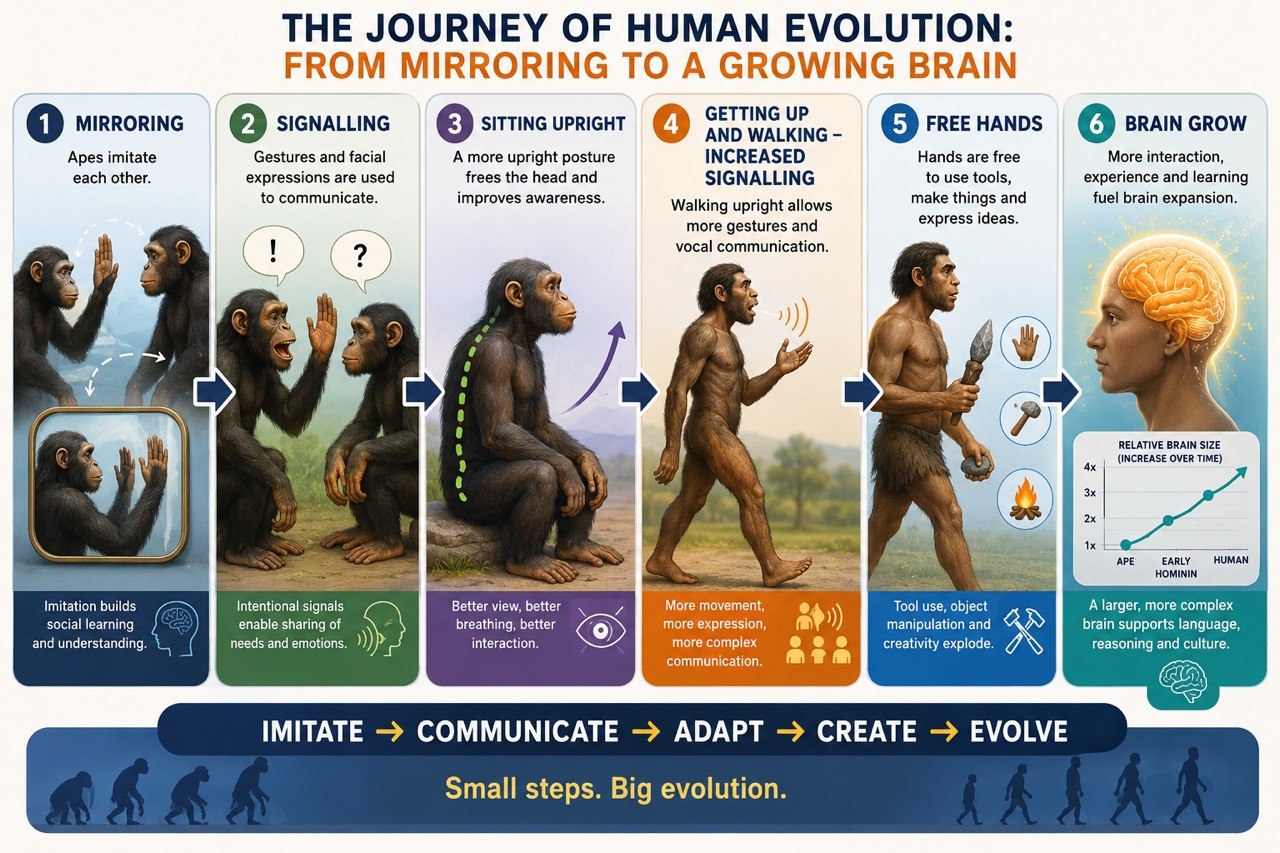
Scientists have identified a fascinating set of brain cells called mirror neurons. These neurons fire when you do something and also when you simply watch someone else doing it. In monkeys, this system sits in a region called the F5 premotor cortex. In humans, the equivalent area is Broca’s area, which is also one of the key regions involved in producing speech. That overlap is not a coincidence. Researchers like Michael Arbib have argued that this mirroring system, originally built for watching and imitating gestures, is essentially the evolutionary ancestor of human language #5.
So why did humans go so much further with this than other primates? A big part of the answer, I think, comes down to walking upright. When we shifted to moving on two legs #1, our hands were suddenly free, not just occasionally, but all the time. Free hands can do things. They can make tools, craft objects, signal meaning, and gesture with increasing subtlety. The brain, in turn, had to grow more complex to keep up with all of that hand activity. And a more complex motor brain, it turns out, is also better equipped for language. The hand and the brain essentially upgraded each other over hundreds of thousands of years.
There is an unusual body of research that makes this connection even more vivid. Uner Tan studied families in which members were born with a condition causing them to walk on all fours. What he found was striking: these individuals also had significant difficulties with speech #2. It is as if, without the upright posture that freed our hands, the whole chain of development that leads to language simply does not follow. Bipedalism, hand use, motor complexity, and language are not separate achievements; they are one interconnected story.
Research by Gentilucci and colleagues adds another intriguing layer: spoken language and arm movements are actually controlled by the same motor system in the brain #3, and their earlier work showed that the hands genuinely “speak”; gesture and verbal meaning are processed in overlapping brain regions #4. Corballis takes this even further, suggesting that human language probably began as a gestural system, with the voice only joining in much later #5. In other words, we may have talked with our hands long before we ever opened our mouths.
We Catch Each Other's Habits — Whether We Mean To or Not
Now here is where this gets personally useful. That same mirror system that helped our ancestors communicate is still running in us right now, every day. And we can actually put it to work.
When we spend time observing and imitating people who handle themselves well, people who stay calm under pressure, who make good decisions, and who carry themselves with confidence, we start to absorb some of those qualities. It does not happen overnight, and it is not magic. It is the brain doing what it was built to do: learn by watching. This is especially handy when our own emotions are getting the better of us. If we are feeling anxious, angry, or low, consciously modeling the behavior of someone more grounded can help shift us out of the spiral.
There is a reason our mothers always said to watch who we spend time with. The people around us do not just influence our habits; they normalize them. They make our patterns feel like the natural way of things. So if we are trying to change a habit, sometimes the single most powerful thing we can do is change the crowd. Not because the people are bad, but because the environment they create is what keeps the old pattern alive. First lose the group, then lose the habit.
The Invisible Rules We All Live By
A lot of our emotional reactions, the flare-ups, the frustrations, the moments where we just cannot let something go, come from a place we rarely examine. We all carry around a set of unwritten personal rules about how life should work. Rules about fairness, about respect, and about what people are supposed to do in certain situations. The trouble is, nobody else has read our rulebook.
Think about it. One person says, “I need to enjoy life,” and for them, that means having a drink at a party. For someone else, that sounds like a poor trade-off entirely. One driver sees a red light on an empty road at six in the morning as a silly rule to follow. Another would never dream of running it. After a long day, one partner wants to sit in front of the TV and decompress. The other has been looking forward all day to a proper conversation. Both needs are real. Both feel completely reasonable from the inside. But without acknowledging the difference, the evening ends in tension that no one can fully explain.
I will be honest, I have my own version of this. Fairness issues really get to me. When I see government rules applied selectively, or bureaucracy expanding into corners of life it has no business being in, it genuinely frustrates me. I feel it viscerally. But I have had to sit with an uncomfortable truth: that frustration does not fix anything. It does not change the system. It just sits inside me and does damage. Knowing that has not made the frustration disappear, but it has made me more deliberate about not feeding it.
This is where reframing comes in. Reframing is not about pretending things are fine when they are not. It is about asking, “Is the way I am interpreting this situation actually helping me?” Sometimes a small shift in perspective — seeing a rule as someone else’s genuine value rather than a personal attack, or seeing a frustrating system as something to navigate rather than something to rage against — makes an enormous practical difference. It is a skill, and like any skill, it gets easier with practice.
Meditation and Imagery: Letting the Mind Lead the Way
Sometimes talking ourselves through a problem is not enough. Sometimes we need to feel our way through it instead. That is essentially what meditation and guided imagery offer.
Rather than trying to logic away a bad habit or emotion, these techniques invite us to sit quietly and picture it differently. We visualize the unwanted pattern, the anxiety, the craving, the anger, and we watch it leave. Then we picture the state we actually want to be in, and we let ourselves settle into that image. It sounds simple, and in a way it is. But it works precisely because it bypasses the argumentative part of the brain and speaks directly to the part that responds to imagery and sensation.
Even something as basic as focusing on a single sound or object, just enough to crowd out the mental noise, can make a real difference. And doing this before bed is particularly worthwhile. Most of us know the experience of lying awake while the day’s unfinished business plays on a loop. A short practice of focused attention or calming imagery before sleep interrupts that loop, and over time, trains the mind to wind down rather than wind up.
Watching Yourself Without Judgment
Here is a technique that sounds odd at first but turns out to be remarkably useful: try looking at yourself as if you were a stranger. Not critically, not harshly — just with the calm curiosity you might bring to watching someone you do not know navigate a difficult moment.
When we are emotionally attached to a situation, our thinking tends to narrow. We defend, we justify, we react. But when we step back, even just mentally, and observe ourselves without that emotional charge, we suddenly have access to questions we could not ask before. What is really going on here? What story am I telling myself? Is that story accurate? What would I actually advise someone else to do in this situation?
It takes practice. But this kind of honest, detached self-observation is one of the most reliable ways to understand why we keep making the same choices and what it would actually take to make different ones.
Finding People Worth Emulating
One of the most natural ways to grow is simply to find people who are doing what you want to do, and pay close attention to how they do it. This is why we read books, why we seek out mentors, and why we watch interviews with people we admire. There is real value in asking: how does this person handle setbacks? How do they manage their emotions? What do they prioritize? And then genuinely trying to apply those principles to our own lives.
For me, Bill Russell is one of those people. A legendary Celtics player and coach, he used everything his reputation gave him to lift his community, not just to build a personal legacy. That kind of purposeful living sticks with you. And it does not have to be someone you know personally. There is a documentary on Netflix called What Would Sophia Loren Do?, and it captures exactly this idea: that someone you have only ever seen on screen can still give you a genuine model for how to carry yourself. Poise, warmth, and resilience — these things come through, and our mirror system picks them up whether we are consciously trying to learn or not.
Set Goals You Can Actually Measure
“I want to be better” is a wish. “I want to go thirty days without a drink” is a goal. The difference matters enormously.
Vague intentions give us too much room to negotiate with ourselves. A clear, measurable target does not. In my own case, the metric is simply the number of consecutive alcohol-free days. The clock is either running or it has been reset. There is no gray area to hide in, no “well, it was just the one” exception. And that clarity is not a burden; it is actually motivating. Watching the number grow gives you something concrete to protect.
Looking at everything we have covered — mirroring, reframing, meditation, self-observation, role models, and clear goals — the common thread is this: none of them work by forcing yourself to be different through sheer willpower. They all work by changing the conditions around your choices, or the way you see those choices in the first place. Willpower runs out. These approaches, if practiced consistently, build something more lasting.
References & Research Inspiration
- Skoyles, John R. “Human balance, the evolution of bipedalism and dysequilibrium syndrome.” Medical Hypotheses 66, no. 6 (2006): 1060–8.
- Tan, Uner. “Two families with quadrupedalism, mental retardation, no speech, and infantile hypotonia (Uner Tan Syndrome Type-II); a novel theory for the evolutionary emergence of human bipedalism.” Frontiers in Neuroscience 8:84 (2014). doi: 10.3389/fnins.2014.00084.
- Gentilucci, Maurizio, Riccardo Dalla Volta, and Claudia Gianelli. “When the hands speak.” Journal of Physiology–Paris 102, no. 1–3 (2008): 21–30. doi: 10.1016/j.jphysparis.2008.03.002.
- Gentilucci, Maurizio, and Riccardo Dalla Volta. “Spoken language and arm gestures are controlled by the same motor control system.” Quarterly Journal of Experimental Psychology 61, no. 6 (2008): 944–57. doi: 10.1080/17470210701625683.
- Corballis, Michael C. “The evolution of language.” Annals of the New York Academy of Sciences 1156 (2009): 19–43. doi: 10.1111/j.1749-6632.2009.04423.x.
- Arbib, Michael A. “From monkey-like action recognition to human language: an evolutionary framework for neurolinguistics.” Behavioral and Brain Sciences 28, no. 2 (2005): 105–24